
BUY MY BOOKS | HOME | FICTION | ESSAYS | ON-LINE DIARY | MARGINALIA | GALLERY | INTERACTIVE FEATURES | FAQ | SEARCH ENGINE | LINKS | CONTACT

www.ralphrobertmoore.com
the official website for the writings of
ralph robert moore
contents copyright © 1998-2016 by ralph robert moore, all rights reserved
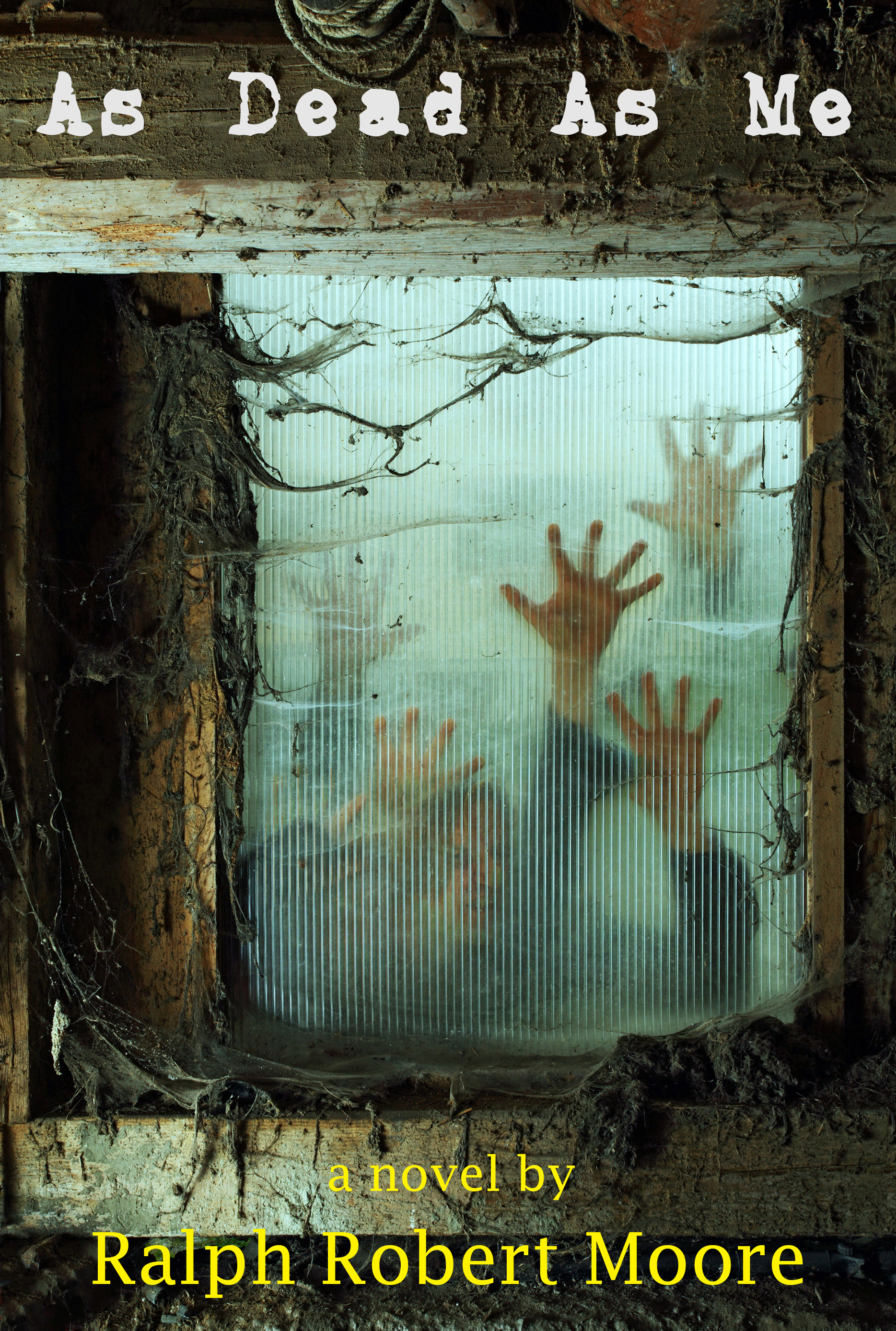
A first person account of the zombie appocalypse, from its beginning to its end.
"It takes something special to interest me in a zombie novel, and this really is something special. Relentless, unsentimental, and with a plot that moves like a freight train. You want bleak? Read this…an excellent novel from an excellent writer." Gary McMahon
"By making his characters so fully rounded, Moore gives us a reason to care about them, and this in turn makes the book's resolution all the more poignant and painful… These are just ordinary human beings, acting with common decency in the face of the unacceptable…Moore has written a zombie novel, but it's not just another zombie novel. He takes the familiar and makes it heartrendingly sad, but not at the expense of the action fans of this subgenre will have come to expect from zombie fare." Peter Tennant
"Rob Moore has done it again; turned a conventional theme of zombies and all the genre cliches that go with it into something that rises so far above the ordinary that it takes your breath away (no pun intended!). This book has depth. It is not only a visceral tour de force, but has the advantage of Moore's extraordinary imagination being brought to bear, introducing characters and situations that you care passionately about. Without giving too much away, the climax to the story astounds the reader by its spectacular, heartrending audacity. A brilliant achievement." Trevor Denyer
Amazon Kindle US
Amazon Kindle UK
Amazon Kindle Canada
Amazon
Amazon UK
Amazon Canada
iTunes, iPhone, iPad, iPod
The NOOK
Lulu
When someone you love dies, are they gone forever?
Meet the Ghosters, and the desperate people who hire them.
In our modern world, only Ghosters know what comes after death. What stays behind. And what dwells between.
Ghosters are a small, loosely-connected group of individuals who travel the highways of America curing people of their hauntings. For as much money as they can negotiate from each client. They are legitimate. But they are not nice.
"…Moore has written a book that contains a thoroughly original and totally convincing portrayal of the supernatural world, one in which cosmic vision and human feeling collide. I loved every single page of it, not least for the wealth of incidental detail and the assured way in which Moore so often circles around the crux of each story, slowly dragging it out into the light of day, letting us see and experience what is really at stake. It does for ghosts what his novel As Dead As Me did for zombies, with bells on." Peter Tennant
"These are not ordinary ghosts and the Ghosters are far from being normal individuals. The ghosts are startlingly original creations from the mind of one of the
most accomplished writers in the field…The solutions to the hauntings are spectacularly horrifying. Once again, Ralph Robert Moore has produced a startlingly original
book that surprises and unsettles with every page turn. He has seamlessly fused these elements with a genuinely sympathetic understanding of character and personal
tragedy that propels this collection into the literary stratosphere. "His work inspires as it reinvents familiar themes, infusing them with something that only the
most talented writers can achieve: a sense of wonder that takes your breath away." Trevor Denyer
"Ghosters…are members of a small group who travel around America "curing" people of their hauntings…All are beautifully drawn characters…There's a lot of humour in this book then but there's also real horror-- the opening and closing stories in particular, set in the upper floors of a haunted mall, contain some truly disturbing imagery--and there's also poignancy, often when you least expect it. The Ghosters themselves are wonderful creations and the skill the author shows in moulding them is also evident in the characters of the clients…[he] manages to invest all his characters with real personality and depth. [Moore]…is an extremely imaginative writer, coming up with some truly original ideas. That skill is demonstrated emphatically in Ghosters and I sincerely hope the world he's created here is one the author will return to in future publications. It's a book I urge you to buy." Anthony Watson
Amazon Kindle US
Amazon Kindle UK
Amazon Trade Paperback US
Amazon Trade Paperback UK
The full 175,000 word text of Father Figure is now available in new trade paperback and Kindle editions, with a 2015 Author's Preface, and an appendix which includes 6,000 words in deleted scenes.
South of Anchorage, accessible only from a mud-rutted road off Seward Highway, lies the town of Lodgepole. After midnight, among the blueberry bushes of White Birch Park, a man climbs on top of a woman and begins making love to her. As her orgasm rises he puts his hands around her throat, shutting off her air. She struggles, not to stop him, but to stop herself from trying instinctively to pull his hands off her throat. As the top joints of his thumb meet at the front of her throat she comes, her cry of orgasm ricocheting around inside her forever.
Daryl Putnam, handsome, bookish, wakes up from a nightmare and decides to do something he hasn't done in years. Take a walk outside at night. Down in the park, at the lime green shores of Little Muncho Lake, he comes across the body of the strangled woman.
The next morning, at the coffee shop of the hospital where he works, Daryl meets Sally, a pretty, dark-haired girl. He's intelligent, she's outgoing. What they have in common is both are living lonely lives. Until today.
Also in the hospital coffee shop, shaking half a can of black pepper onto his tomato soup, is Sam Rudolph, a fiftyish man with eyes like an angry dog's, who has spent over twenty years quietly manipulating events in Daryl and Sally's lives to have this seemingly chance encounter among the three of them occur.
And who is actually a lot older than fifty.
"It is easy to see why Father Figure has become an underground classic over the years. It is a dark, extremely disturbing but completely gripping suspense thriller with a strongly erotic subtext...Moore is an extremely talented writer with a gift for pushing the reader's emotional buttons...certainly liable to become a cult classic, and deservedly so." --Editorial Review
Amazon US Trade Paperback and Kindle
Amazon UK Trade Paperback and Kindle
My second short story collection, I Smell Blood, is now available as a trade paperback and e-book download. Almost 100,000 words of fiction, including eight stories and my short horror novel, Kid.
"With eight stories and the short novel "Kid", the new collection…combin[es] horror and gonzo invention in a winning combination, with an unadorned prose style that…drives the narrative forward at a cracking pace and allows for moments of surprising tenderness. …Finally we have the short novel "Kid", weighing in at approximately a hundred and twenty pages, and the undoubted highlight of this collection…The novel's eponymous hero is a young man with the ability to head hop, to enter and insinuate himself into the mind of another and eventually seize control of his body…there's plenty of explicit sex and violence, with the scenes in which a man's face is removed particularly horrific…crime lord Knuggles is a master stroke of invention…the man oozes menace, and I cringed in anticipation of something terrible taking place every time he held centre stage…A particular highlight is the dazzling and vividly cinematic shoot out at a restaurant when the kid takes on another head hopper, each of them controlling a selection of stooges..."Kid" was a wonderful finale to one of the best collections I've read this year, delivering exactly the kind of uncompromising thrills and spills I've come to expect from this writer." Peter Tennant
"Ralph Robert Moore's second collection confirms the excellent qualities displayed in his previous book "Remove the Eyes", namely a powerful imagination, an extraordinary degree of originality and a great storytelling ability… A highly recommended book." Mario Guslandi
One thing that is very evident from the moment you start reading [I Smell Blood]: these stories are far from predictable…The characters here inhabit surreal worlds grounded in reality but full of outrageous surprises. "Visibility" [is] a tale so rich in character and atmosphere that it takes your breath away….["Afoot"] drills deep into what motivates people to want to break away from a society that confines our base instincts... The novel, "Kid", is a faultless mix of sure-fired observation…that hinges upon a plot that combines a dark and morbid supernatural ability with a crime mystery…Once more, the author has created a fascinating ensemble of characters…Moore's work is consistently fascinating, original and devastating. His characters speak to you from whatever hell they inhabit, with clear, unambiguous voices...[I Smell Blood] is a worthy successor to "Remove the Eyes." Trevor Denyer
Amazon Kindle US
Amazon Kindle UK
My Storefront
Amazon
Amazon UK
Amazon Canada
Barnes and Noble
Abe Books
The Apple Store
Barnes and Noble's NOOK reader
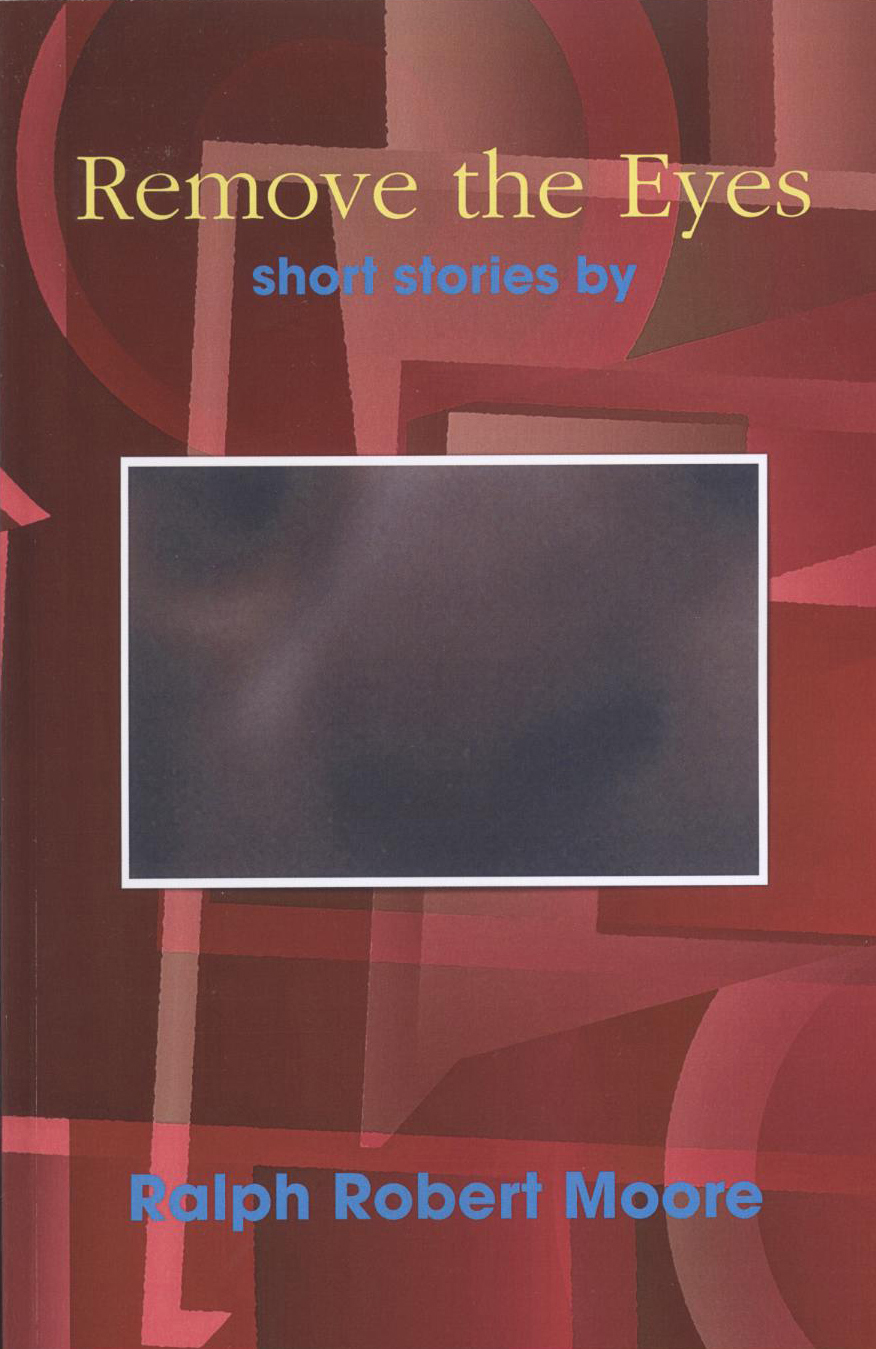
My first short story collection, Remove the Eyes, is available as a trade paperbook, Kindle, and e-book download.
"Tired of the usual suspects? Bored with the same old genre clichés? Then follow my advice and read Ralph Robert Moore, a hell of a writer whose work is provocative and refreshing, never ordinary, always imaginative and graced by a compelling narrative style…Moore has all the features of a great writer: he conceives original plots, creates credible characters and makes them speak plausible dialogues, and, most of all, is a terrific storyteller. Try him, you won't regret it." Mario Guslandi
"…[Moore's] work is not quite like that of anybody else. He is a true original, someone who has taken on board the lessons of genre and mainstream, then harnessed both to his own ends, and if you are looking for something different, then I can't recommend this collection highly enough." Peter Tennant
"Unusual, erotic, frightening and stunningly good…This collection showcases the wide and versatile range of [Moore's] work. From the horrors of the internal demons that infest the wonderful "The Machine of a Religious Man" to the powerful and erotic, yet despairing "Rocketship Apartment", these stories capture the extremes of human experience. The writing is tight and uncompromising. The dialogue provides depth to the narrative, drawing the reader into shocking and unusual scenarios that stun, remaining in the memory long afterwards." Trevor Denyer
Amazon Kindle US
Amazon Kindle UK
Amazon
Amazon UK
Amazon Canada
Barnes and Noble
Abe Books
fiction
Please go here to buy my novels and short story collections.
novels | short stories/novelettes | one-paragraph stories | special projects
This section of SENTENCE features a large selection of my fiction, so you can decide if you like my style.
The complete texts of 11 of my short stories and novelettes are included, as well as a number of my fiction experiments, and lengthy excerpts from two of my novels.
I hope you enjoy them, and gain a better sense of who I am by reading them.
William S. Burroughs liked to quote Hassan i Sabbah, the eleventh century founder of the Ismaili sect known as the Assassins. "Nothing is true. Everything is permitted."
I cannot think of a more powerful statement.
If we accept that truth does not exist, that it would be dangerous if indeed truth did exist, in that if it did, its finality would lock us into the finite, into a closed box filled with clickings, then we are indeed blessed to live in a universe in which we may believe anything we want, a universe in which everything is permitted.
I love fiction.
I love telling lies. I love the freedom of creating people who don't exist, putting them in rooms, busy streets, rolling green countrysides, boats bobbing atop ocean swells that do not exist, except in my day dreams, my typing fingers.
Fiction is not reality. Anymore than a shimmer above distant sand is an oasis. Whatever reality is, assuming it does in fact exist, fiction cannot duplicate it. At its very, very best, the most fiction can do, with a rhyme, a wet daub of yellow orange pigment, a piano melody played in a minor key, is remind us of reality.
novelsWhenever I've written a novel, I've had the experience of being in those rooms, smelling the cool freshness of that inked-in rain, perambulating within the limbs and clothes of those characters, male and female, I've created. I know what's in the pockets of their pants, when they don't. You live with them for months, sometimes years, eventually coming to have some feeling for, as in real life, even the bad ones, only you knowing her rush into his arms, the rages in the kitchen, train journey up the mountainside, will end, and at your hand. I wonder sometimes if characters, in the heat of a scene, spitting out their lines polished by someone else, ever sense, as a ghost, the man or woman quietly standing by the wall, hands folded, having them suffer through a scene again and again for what is, to them, still the first time.
John Gardiner said novelists are monks, and that's true. There's nothing more cloistered than a writer in a car, subway, plane, people-mover or elevator, listening not to the outside world but his or her own inward world.
Vladimir Nabokov got excited about his short story Lolita when it grew the 'wings and claws of a novel'. How true. We make the world not what it is, not what we want it to be, not what we fear that it is, but rather what it must be, in a novel.
A novel, like all writing, is a compensation. A pathway, in pages, to a different world. Not better, not worse, but different. All art gives us that glimpse, not of the better, nor the worse, but only, always, heroically, of the different.
novelsThe Birds Wake Up The Monkeys Opening of the Novel
Ralph Robert Moore reads the opening of Always Again
"Brains must be handled carefully or they will fall apart."
--Julia Child, The French Chef Cookbook
Four hundred years ago, near the River Niger in northwestern Africa, a man and woman are pursued by a tribe with white T's painted across their foreheads, down the bridges of their noses.
In 1982, Peter Broome, living in comfortable retirement in Burlingame, California receives notice that Roger Moran and his wife Maddy have died. With the lawyer's notice are three boxes of out of focus photographs of Moran, and reel-to-reel and cassette tapes of Moran's day to day life over the past several decades.
In 1955, in North Hollywood, California, Broome first meets Moran after having married his only child, Claudia. Moran eventually tells Broome his life story, starting in 1928 when he first met Claudia's mother, Maddy, in San Francisco.
ALWAYS AGAIN is the story of two people, Roger and Maddy Moran, who believe they are reincarnated lovers. Old love in new bodies. Just as they are about to discover who they really are, and why they alone reincarnate, Maddy, in an assault, suffers irreparable brain damage. Roger must go through the rest of this reincarnation with his lover impaired, unable to provide the necessary clues to their multi-life existence to have it all make sense.
ALWAYS AGAIN was my first novel. I wrote it in Portland, Maine in 1983, after Mary and I moved there from California, in the top, third floor apartment of a multi-tenant house. There were dwarf doors on either end of the kitchen leading under the eaves, and windows in the bedroom so high you had to step up onto the seat of a chair to open or close them. Each day I'd drive Mary through the snow to her job, then come home, reheat the coffee, settle in an easy chair with a legal pad on my lap, and take off into the world of words.
ALWAYS AGAIN is unpublished at this point.
novelsIt Is Wet Here Opening of the Novel
Going Through Sylvia Daryl autopsies the woman he found
The Coldness People Walk Over Introduction of Sam Rudolph
Coffee Shop Tension Introduction of Sally Dolumbo; Daryl, Sam and Sally interact
Eight Legs, Three Cunts Daryl is woken up after his first date with Sally
Back Yard Talk Daryl and Sally's second date
In Someone Else's Apartment Daryl and Sally snoop through Sylvia Gold's things
"I Don't Want To Squeeze The White Part" Daryl accepts a dinner invitation from Sam
Big Dark Hole Sheriff Bob Cable enlists Daryl for a body transport
Ralph Robert Moore reads the opening of Father Figure
"...because you're mine."
--Screamin Jay Hawkins
South of Anchorage, accessible only from a mud-rutted road off Seward Highway, lies the town of Lodgepole. After midnight, among the blueberry bushes of White Birch Park, a man crawls on top of a woman and begins making love to her. As her orgasm rises he puts his hands around her throat, shutting off her air. She struggles, not to stop him, but to stop herself from trying instinctively to pull his hands off her throat. As the top joints of his thumb meet at the front of her throat she comes, her cry of orgasm ricocheting around inside her forever.
Daryl Putnam, handsome, bookish, wakes up from a nightmare and decides to do something he hasn't done in years. Take a walk outside at night. Down in the park, at the lime green shores of Little Muncho Lake, he comes across the body of the strangled woman.
The next morning, at the coffee shop of the hospital where he works, Daryl meets Sally, a pretty, dark-haired girl. He's intelligent, she's outgoing. What they have in common is both are living lonely lives. Until today.
Also in the hospital coffee shop, shaking half a can of black pepper onto his tomato soup, is Sam Rudolph, a fiftyish man with eyes like an angry dog's, who has spent over twenty years quietly manipulating events in Daryl and Sally's lives to have this seemingly chance encounter among the three of them occur.
And who is actually a lot older than fifty.
FATHER FIGURE was written in San Antonio, Texas (Part 1) and Dallas, Texas (Parts 2 and 3). Mary and I would garden in the morning under the hot sun, digging holes and wiping the backs of our green gloves across our brows, then I'd climb the stairs to my quiet library and with dirty fingernails tap sentence after sentence into the computer until late in the evening.
FATHER FIGURE is 175,000 words long, and is divided into three parts: Love, Sex and Death. All the excerpts below are from Part One, except the final excerpt, which is from Part Two. The excerpts are presented in sequential order. The excerpts are not continuous (i.e., there are scenes between the excerpts not included here).
FATHER FIGURE contains explicit sexuality and violence, as well as ideas some might find disturbing.
FATHER FIGURE was published in March, 2003 by Bookbooters in a trade paperback edition. Bookbooters has unfortunately since gone out of business. You can download the entire novel, for free, in PDF format, by going here. Or you can buy it in trade paperback or Kindle format by going here.
Artist Jason Mcaloon is in the process of reimagining the entire text of FATHER FIGURE as a typographical design project. Here's his interpretation of the opening page of the novel. Jason's website is located here.
short stories/novelettes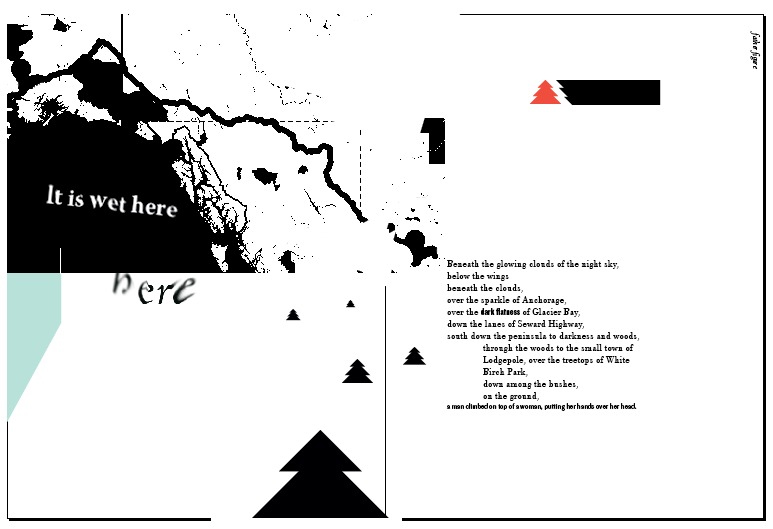
Big Inches | This Moment of Brilliance | When the Big One Thaws | Zombie Betrayal | Strangers Wear Masks of Your Face
A short story is a game played between writer and reader. The reader steps from word to word through the sentences, down the paragraphs, not certain where he or she is being led. Parts of the path are so well prepared -- a description, a dialogue -- we walk back up a stretch of stones just for the pleasure of strolling back down the paragraph again. In the best stories, the reader is called to the clearing of the final sentence, where the writer's short stab slides in.
The act of reading, at least in English and other European languages, is from left to right to the end of a line, then right to left to see the beginning of the next line, then left to right again, and so on. The act of reading, in effect, is a spiral slowly headed downwards.
As we descend into this worldlet built for us, even our attention to the details crafted for our pleasure does not allow us to see what the author has hidden here and there along the way. These may be revealed at the end, held out in the author's palms so that we want to travel back to a particular curve to uncover the clue concealed there, or may be revealed only on a rereading, or may remain forever buried, stepped over countless times, but never studied.
But that's all part of the game.
All the stories presented here are in Adobe Acrobat PDF format. PDF allows for a more easily-readable format, and it's perfect for printing. You're more than welcome to print a story, hand it to a friend, email it as an attachment, etc. All I ask is that you not change anything, and include my authorship and copyright information. You cannot display anything other than excerpts of a text on a website (although you're welcome to link to a story on my site from your site), and of course you can't include a story in an anthology, magazine or other publication without my express written consent.
The first group of stories presented here are, like most stories, unrelated to each other. They're not part of a larger story cycle. Think of them as strangers to each other, riding on the same train, but reading different newspapers.
BIG INCHES tells of a passage many readers associated with drug smuggling, although when I wrote the tale I was more concerned with metaphysics than methamphetamine. It always surprises me how others interpret something I've written. There's a certain amount of magic amok in this story, from the machine-tapping to the rolled-up sleeves at the end. The ideal reader will realize that 'Pottah', its two syllables separated and the letters in each syllable reversed, spells 'top hat'.
THIS MOMENT OF BRILLANCE is about a wet work specialist who comes undone in the Maine-Florida corridor. I wanted the shortest, simplest possible name for him, which is why I chose 'Ed'.
In WHEN THE BIG ONE THAWS we meet a man who has a beautiful wife, an adorable baby, but who is filled with doubts that get only worse when the green mud in the pond behind their house starts unfreezing.
The idea for ZOMBIE BETRAYAL occurred after Mary and I saw our hundredth or so cheap European horror film on video, the type that's always a joint production among Spanish, Italian and sometimes German film companies. I found myself starting to imagine a married, middle-aged couple who act in these films, one of them experiencing, after so many scenes with fake death, a brush against the real thing. As a writer I was also intrigued by the idea of starting a story funny, then moving towards sorrow.
STRANGERS WEAR MASKS OF YOUR FACE explores the idea of the path not taken. What if we could--not go back, because of course you can't--but step off the path we did choose, walk past tree trunks, stepping on pine cones, to join that other path further up the trail?
Big Inches was first published in the Winter 1989 issue of Space & Time, and reprinted in the April, 2001 issue of ChiZine. In 2011, Cast Macabre, run by Barry J. Northern, did a podcast of Big Inches. You can listen to the podcast here. This Moment of Brilliance was first published in 2004, in Lullaby Hearse number 5, and reprinted in my short story collection, Remove the Eyes. When the Big One Thaws was first published in 1999 in the Summer issue of Fugue Magazine, and reprinted in my short story collection, I Smell Blood. Zombie Betrayal is unpublished at this point. Strangers Wear Masks of Your Face was first published in 2008 in issue 25 of Theaker's Quarterly Fiction, and reprinted in my short story collection, Remove the Eyes.
The next group of stories belong to my story cycle The Sex Act. Writing is a weapon aimed against the world. With The Sex Act stories, I decided to aim at sexuality. Because sexuality is more distorted than we will admit, I wrote these stories through the funhouse exaggeration of sexual obsession. Although these stories feature male characters with different names and faces, all are meant to chronicle the sexual odyssey of the same male. Think of it as the spirit of sexual distortion gliding urethrally through the stories fuck to fuck.
Three stories from the cycle are included here. In the first, TRUTH BE TOLD, the main character explores the power and pitfalls of lies. Years later, in SEX ON SHEETS, our hero has learned to manipulate others. THE RAPE portrays total commitment to obsession, and includes as a bonus a speed bump for speed readers.
Truth Be Told was originally published in 2007 in Sein und Werden Volume 1, Number 4. Sex on Sheets was originally published in 1987 in Sign O' the Times, the Winter '87-'88 issue, and reprinted in 1992 in the anthology Ten Years of the Best of Sign O' the Times. Several paragraphs of the text of Sex on Sheets were edited-out for its publication in Sign of the Times. Those paragraphs are restored here. The Rape was originally published in 2006 in Sein und Werden Volume 1, Issue 2.
Another story cycle of mine, Recorded Occurrences, experiments with the illogical narrative of dreams. Our world lives next to another world. Your profile rests against your pillow, your ear down in the softness, the warmth, the weave, hearing, then listening. You gaze at the wall, soon seeing patterns, soon movement, soon a small white hand reaching out, offering. The premise of each Recorded Occurrences story is absurd, but the narrative then attempts to develop that premise in an orderly manner, although more through association than conventional plot. Each story is told in the second person, to encourage the reader to feel the story as being his or her own dream. The stories are a lot of fun to write. Not only because of the challenge I face with each, having to follow the rules I've set up, but also because they allow me to approach the whole idea of story-telling in a different way.
GRAPPLING WITH URINE tells the story of someone visiting a wealthy woman. CAT HEAD is about a teenage boy who arrives home while his parents are still out, and sees something odd in the backyard. RUMP-A-THUMP covers a terrible accident that occurs while the protagonist is in San Francisco to give a speech.
Grappling with Urine was first published in 2008 in Chimeraworld Number 5. Cat Head was first published in the July, 2004 issue of Lunatic Chameleon. Rump-a-Thump was first published in 1999 in ROADWORKS number 9.
one-paragraph stories
I've counted them twice now
I fucked his girlfriend while he watched
In the cafe we ordered our food
I was told it would be different
In Panama we lived in an apartment
He no longer recognized his face
I am reasonably certain I locked the door
I came to not knowing where I was
The text has become corrupted
Having a drink in a bar
By the third day the birds were eating the dead
Something's replacing your bones the dentist said
That's the way punks think
He dyed his part the same color as her hair
When cockroaches start farting
Sometimes when he fell asleep
Entering the iron train
Clanging up the iron stairs
We used to put them in olives, Meg says
The coolest kids gather in Father McCauley's outer office
Walk down to the end of the block
We have won driving down the street
I've always felt it's nicer to use female urine
The smell of mcdonald's french fries in the bedroom where you died
The best thing about her are her dark eyebrows
Each of these one-paragraph stories push the stylistic concepts explored in my Recorded Occurrences stories, discussed above, to a further extreme. Here, the illogic is emphasized to an even greater degree, by deliberately stripping out most of the elements of a conventional narrative, taking only bits and pieces of a story and jamming them together to force some kind of sense in the chaos of one long, unpunctuated sentence. These experiments differ from most extremely short fiction in that each actually does develop a story from beginning to end, and each eschews the easy out of simply juxtaposing unrelated phrases within a single paragraph for a surreal effect.
Like a hole being dug, the texts at the bottom of the list are more recent than those near the surface.
I Fucked His Girlfriend While He Watched, In Panama We Lived In An Apartment, and He No Longer Recognized His Face were originally published in 2007 in Sein und Werden, Volume 2, Issue 1.
special projectsantarctica
the maddox family home page
Back in 2000, I started a second website, Jump Down The Hole, now defunct, in which I explored different ways of creating fiction, not through linear narrative, but instead through popular website formats.
In Antarctica, I wanted to explore a 'what if' idea. What if Antarctica, rather than being a cold, barren wasteland, was instead a populous nation of beautiful cities, green forests, blue lakes, pink glaciers, with a history going back 40,000 years? Rather than simply writing a story about that notion, I decided to create a fictional tourist-type website devoted to Antarctica, much like sites created on behalf of Germany, New Zealand, or Brazil.
In The Maddox Family Home Page, I wanted to write a story about a single, middle-aged father raising a daughter. Normally, I'd do that using conventional narrative to create a novelette, but this time I decided to tell their story piecemeal, through the different pages of their family website, the father's on-line diary, poetry page, recipes page, and the site's guestbook all contributing insights into their lives, all the pages together revealing the full story.
This mimicking of popular website formats intrigued me also because it allowed the reader, by choosing links according to their own preference, to start anywhere they wanted within the fiction, then explore the lie in a sequence determined by their own link clickings.